

When comparing technical and human-centric approaches to insider threat mitigation, most security teams discover an uncomfortable truth: neither side works well alone. Your firewall typically cannot stop an employee who already holds legitimate credentials and access. Your security awareness training is unlikely to catch a disgruntled administrator exfiltrating data at 2 a.m. The real question is not which approach wins — it is how you combine them so they cover each other's blind spots. This article gives you a practical decision matrix, a step-by-step integration playbook, and the pitfalls that derail insider threat programs. Whether you run a SOC, lead an awareness program, or own risk for your organization, you will walk away with a reusable framework you can adapt today.
What Is Insider Threat Mitigation?
Insider threat mitigation is the set of controls, processes, and cultural practices an organization uses to prevent, detect, and respond to threats originating from people who have authorized access — employees, contractors, or trusted partners. MITRE ATT&CK documents several techniques commonly used by insiders, including T1078 Valid Accounts, where adversaries obtain and abuse credentials of existing accounts [1]. NIST SP 800-53 Rev. 5 groups the relevant safeguards across multiple control families, including Personnel Security (PS), Awareness and Training (AT), and Audit and Accountability (AU) [2].
In practice, this means your program must address both the technical signals (unusual data transfers, privilege escalation) and the human signals (disengagement, policy ignorance, coercion) that precede an insider incident.
Why It Matters for Security Teams
Insider threats sit at the intersection of technical controls cybersecurity teams deploy and the human element security leaders try to influence. NIS 2 Directive Article 21(2)(i) requires measures covering "human resources security, access control policies and asset management" [3]. CIS Controls v8.1 dedicates Control 14 — Security Awareness and Skills Training — entirely to the human side, while Controls 3 (Data Protection), 5 (Account Management), and 6 (Access Control Management) cover the technical side [4].
In practice, this means a gap on either side creates a gap in overall defense. A purely technical program misses social-engineering vectors; a purely human program misses credential misuse at machine speed.
How to Build a Balanced Insider Threat Program Step by Step
Prerequisites and Setup
Before designing controls, you need three foundations:
| Foundation | What to Establish | Key Owner |
|---|---|---|
| Asset inventory | Identify crown-jewel data and systems | IT / Data owners |
| Baseline behavior | Define normal access patterns per role | SOC / IAM team |
| Policy framework | Acceptable-use policy, data-handling policy | Legal / CISO |
NIST CSF 2.0 places asset management under the Identify function (ID.AM) and awareness under the Protect function (PR.AT) [5]. Start there.
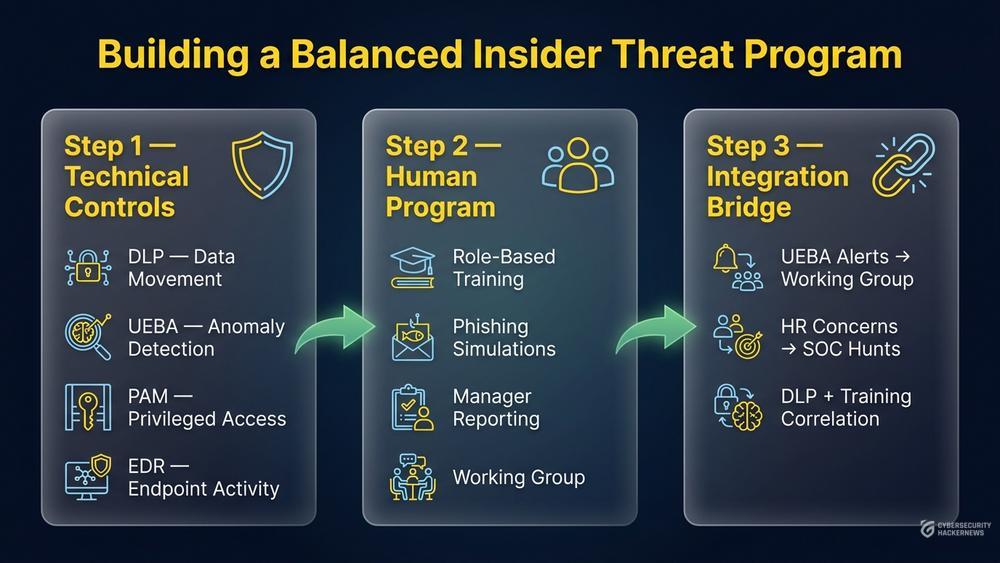
Step 1 — Map the Technical Control Layer
Deploy controls that generate telemetry about insider activity. The table below aligns control types with their insider-threat function:
| Control Category | Insider-Threat Function | Example Tools |
|---|---|---|
| Data Loss Prevention (DLP) | Detect and block unauthorized data movement | Microsoft Purview, Symantec DLP |
| User and Entity Behavior Analytics (UEBA) | Baseline and anomaly detection | Splunk UBA, Exabeam, Microsoft Sentinel |
| Privileged Access Management (PAM) | Session recording, just-in-time access | CyberArk, BeyondTrust, HashiCorp Vault |
| Endpoint Detection and Response (EDR) | Detect suspicious endpoint actions | CrowdStrike Falcon, Microsoft Defender for Endpoint |
| Network monitoring | Detect unusual lateral movement or exfiltration | Zeek, Suricata, Darktrace |
In practice, this means you are not buying tools for their own sake — each tool fills a detection gap in the insider kill chain.
Step 2 — Build the Human-Centric Program Layer
Technical telemetry tells you what happened. Behavioral security programs help you understand why and intervene earlier. Security awareness training is the starting point, but mature programs extend beyond it:
| Program Element | Purpose | Frequency |
|---|---|---|
| Role-based security awareness training | Reduce accidental insider incidents | Quarterly + on-boarding |
| Phishing simulations | Measure susceptibility, reinforce training | Monthly |
| Manager reporting channels | Surface behavioral warning signs early | Continuous |
| Psychological safety culture | Encourage self-reporting of mistakes | Continuous |
| Insider threat working group | Cross-functional triage (HR, Legal, Security, IT) | Bi-weekly |
NIST SP 800-50 Rev. 1 provides guidance for building a cybersecurity and privacy learning program that addresses these elements systematically [6].
Step 3 — Integrate Both Layers with a Detection-Response Bridge
Neither layer should operate in a silo. Connect them:
- Feed UEBA alerts into the insider threat working group for behavioral context.
- Use HR-reported concerns as hunt hypotheses for the SOC.
- Correlate DLP alerts with recent policy-training completion data — a user who just completed data-handling training and still triggers a DLP alert is a higher-priority case.
Decision Matrix: Technical vs Human Investment
Use this matrix to guide your budget allocation based on your organization's risk profile. Assign a weight (1–5) to each factor, then total the scores.
| Risk Factor | Favors Technical Controls | Favors Human-Centric Programs |
|---|---|---|
| High volume of privileged users | Weight: 5 | Weight: 2 |
| Remote / hybrid workforce | Weight: 4 | Weight: 4 |
| High employee turnover | Weight: 3 | Weight: 5 |
| Regulated data (PCI, GDPR, health) | Weight: 5 | Weight: 3 |
| History of accidental data leaks | Weight: 2 | Weight: 5 |
| Advanced persistent insider risk | Weight: 5 | Weight: 3 |
How to adapt this matrix: Score each factor for your environment. A total that skews above 20 on the technical side suggests starting with DLP and UEBA investments. A total above 20 on the human side suggests prioritizing your training program and reporting culture. Most organizations land in the middle, which reinforces the case for balanced investment.
Best Practices
- Start with data classification. You cannot protect what you have not labeled. Classify data before deploying DLP rules.
- Baseline before alerting. Run UEBA in learning mode for at least 30 days before activating alerts — otherwise false positives will overwhelm your analysts.
- Make reporting safe. Employees who fear punishment for honest mistakes will hide them. A no-blame reporting channel for accidental policy violations catches problems early.
- Separate detection from investigation. SOC analysts detect anomalies; the insider threat working group (with HR, Legal) investigates. Mixing these roles creates legal and ethical risks.
- Measure both layers. Track technical metrics (mean time to detect insider anomalies, DLP true-positive rate) alongside human metrics (training completion, phishing simulation click rate, self-report volume).
- Revisit quarterly. Insider threat patterns shift with organizational changes — mergers, layoffs, and role transitions all change the risk profile.
ISO/IEC 27002:2022 organizes its 93 controls across four themes: organizational, people, physical, and technological [7]. An effective insider threat program touches at least the people and technological themes.
In practice, this means your best-practice checklist should map each item to at least one control theme.
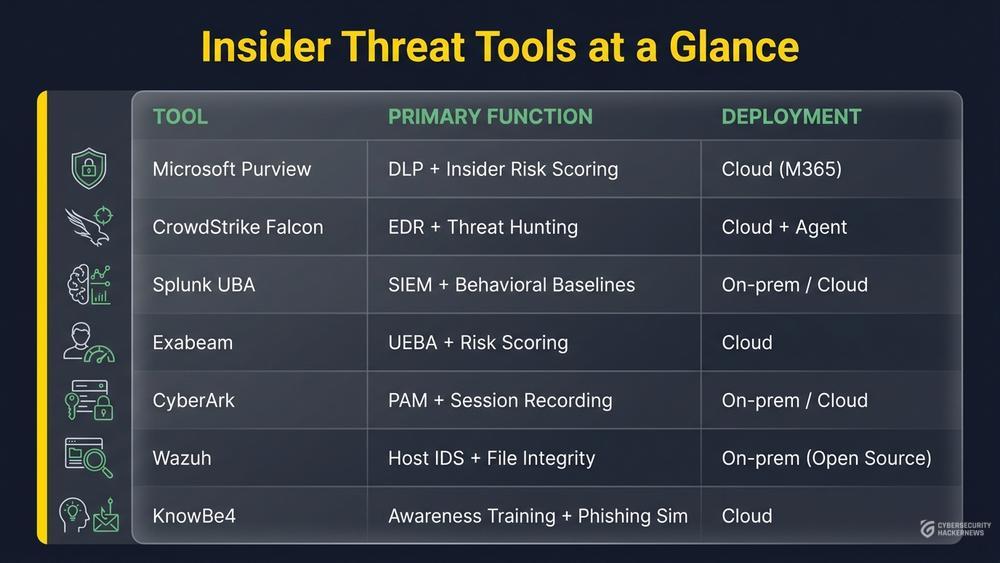
Tools Comparison
| Tool | Primary Function | Insider Threat Relevance | Deployment Model |
|---|---|---|---|
| Microsoft Purview | DLP, data classification, insider risk management | Unified insider-risk scoring across endpoints and cloud | Cloud (M365) |
| CrowdStrike Falcon | EDR, threat hunting | Endpoint telemetry for credential misuse and data staging | Cloud + agent |
| Splunk (UBA add-on) | SIEM + UEBA | Behavioral baselines, anomaly detection | On-prem / cloud |
| Exabeam | UEBA, SIEM | Session-based user timelines, risk scoring | Cloud |
| CyberArk | PAM | Session recording, credential vaulting, just-in-time access | On-prem / cloud |
| Wazuh | Host-based IDS, file integrity monitoring | Detect unauthorized file access and configuration changes | On-prem (open source) |
| KnowBe4 | Security awareness training, phishing simulation | Reduce accidental insider incidents through training | Cloud |
Each tool covers a different slice of the insider threat surface. No single product addresses both technical controls and human-centric programs — which is precisely why integration matters.
Real-World Example (Illustrative Scenario)
⚠️ Disclaimer: The following scenario is an illustrative example based on typical industry patterns. The specific metrics are hypothetical estimates designed to demonstrate realistic outcomes, not measured data from a documented project. They should not be cited as factual benchmarks.
Context: A mid-size financial services firm with 2,000 employees, a five-person SOC, and a compliance team managing PCI DSS and GDPR obligations. The firm had deployed DLP and SIEM but had no formal insider threat working group or structured behavioral security programs.
Challenge: The SOC was receiving DLP alerts but lacked behavioral context. Alerts were triaged purely on volume and severity, with no input from HR or management. Accidental data leaks by employees who misunderstood data-handling policies blended with genuinely suspicious exfiltration attempts, creating alert fatigue.
Solution: The firm established a cross-functional insider threat working group (Security, HR, Legal, Compliance) meeting bi-weekly. They layered UEBA on top of existing SIEM to create behavioral baselines. Simultaneously, they rolled out role-based security awareness training quarterly and a confidential reporting channel for employees to self-report policy mistakes.
Results (illustrative estimates):
- Mean time to triage insider-related alerts decreased by roughly 55% (illustrative)
- Accidental data-handling incidents declined by approximately 65% after two training cycles (illustrative)
- Self-reported policy mistakes increased roughly threefold, catching issues before they triggered DLP alerts (illustrative)
- Alert-to-investigation handoff time improved by approximately 70% due to behavioral context from the working group (illustrative)
Key Takeaways: Technical detection without human context produces noise. Human reporting without technical telemetry misses covert actions. The working group became the bridge, making both layers more effective than either alone.
Security Technology vs Training: Common Pitfalls
When evaluating security technology vs training, teams frequently make these mistakes:
1. Over-investing in technology while neglecting culture.
Buying a UEBA platform while running a checkbox-style annual training session sends a clear message: the organization trusts tools more than people. Employees disengage, and reporting drops.
2. Treating awareness training as a compliance exercise.
If your training exists solely to satisfy an audit requirement, it is unlikely to change behavior. Effective training is role-specific, scenario-based, and reinforced with simulations.
3. Failing to establish a cross-functional working group.
Without HR, Legal, and management at the table, the SOC lacks the authority and context to investigate insider cases appropriately. This creates legal exposure and slows response.
4. Ignoring the departing-employee window.
The period between an employee's resignation and their last day is a peak risk window. Failing to adjust monitoring and access during this period is a common and preventable gap.
5. Collecting telemetry without a response playbook.
UEBA and DLP generate data. Without a documented escalation path — who to contact, what evidence to preserve, when to involve legal — alerts sit in a queue.
6. Applying a one-size-fits-all approach.
A software engineer's normal data access pattern looks very different from a finance analyst's. Failing to segment baselines by role increases false positives and misses true anomalies.
Next Steps
- Audit your current insider threat coverage. Map your existing controls against both columns of the decision matrix above. Identify which risk factors you are under-covering.
- Stand up a cross-functional working group. Even an informal monthly meeting between Security, HR, and Legal is better than operating in silos.
- Deploy or tune UEBA baselines. If you already have a SIEM, explore its UEBA capabilities or evaluate add-on modules. Run in learning mode for 30 days before activating alerting.
- Redesign your awareness program around roles. Replace generic annual training with quarterly, role-specific sessions that address realistic insider scenarios your organization actually faces.
- Review the NIST SP 800-53 Rev. 5 Personnel Security (PS) and Awareness and Training (AT) control families [2] and map them to your current gaps.
Sources
[1] MITRE, "T1078 Valid Accounts," MITRE ATT&CK. [Online]. Available: https://attack.mitre.org/
[2] NIST, "Security and Privacy Controls for Information Systems and Organizations," NIST Special Publication 800-53 Rev. 5, 2020. [Online]. Available: https://csrc.nist.gov/pubs/sp/800/53/r5/final
[3] European Parliament and Council, "Directive (EU) 2022/2555 on measures for a high common level of cybersecurity across the Union (NIS 2 Directive)," 2022. [Online]. Available: https://eur-lex.europa.eu/eli/dir/2022/2555/oj
[4] Center for Internet Security, "CIS Critical Security Controls Version 8.1," 2024. [Online]. Available: https://www.cisecurity.org/controls/v8-1
[5] NIST, "The NIST Cybersecurity Framework (CSF) 2.0," NIST CSWP 29, 2024. [Online]. Available: https://csrc.nist.gov/pubs/cswp/29/the-nist-cybersecurity-framework-csf-20/final
[6] NIST, "Building a Cybersecurity and Privacy Learning Program," NIST Special Publication 800-50 Rev. 1, 2024. [Online]. Available: https://csrc.nist.gov/pubs/sp/800/50/r1/final
[7] ISO/IEC, "Information security, cybersecurity and privacy protection — Information security controls," ISO/IEC 27002:2022, 2022. [Online]. Available: https://www.iso.org/standard/75652.html