
Adopting best practices for effective control tailoring in NIST SP 800-53 can mean the difference between a security program that fits your organization and one that drowns your team in irrelevant paperwork. NIST SP 800-53 Rev. 5 defines over 1,000 individual controls across 20 control families [1]. No single system needs them all. Tailoring is the formal process of scoping, parameterizing, and supplementing those controls so they match your actual risk, mission, and technology stack. This article gives you a repeatable workflow, a reusable decision matrix, and concrete pitfalls to avoid.
What Is Control Tailoring?
NIST SP 800-37 Rev. 2 defines seven Risk Management Framework (RMF) steps: Prepare, Categorize, Select, Implement, Assess, Authorize, and Monitor [2]. Tailoring sits inside the Select step. It is the activity where you take a baseline set of controls—chosen after system categorization—and adjust them to reflect organizational conditions, threat landscape, system architecture, and operational constraints.
In practice, this means you are not simply checking boxes on a spreadsheet. You are making deliberate, documented decisions about which controls to apply, how to set their parameters, and which ones to exclude with justification.
Why It Matters for Security Teams
A poorly tailored baseline creates two failure modes. Over-control wastes analyst cycles on requirements that do not reduce risk for your specific system—think mandatory smart-card authentication on an air-gapped sensor that has no card reader. Under-control leaves gaps that adversaries exploit. Risk-informed tailoring eliminates both extremes by linking every control decision to a documented risk assessment.
NIST SP 800-53 Rev. 5 organizes its controls into 20 families such as Access Control (AC), Audit and Accountability (AU), and Incident Response (IR) [1]. Tailoring touches any of these families. The goal is a control set that is defensible during an audit, affordable to operate, and effective at reducing the risks you actually face.
How to Tailor NIST SP 800-53 Controls Step by Step
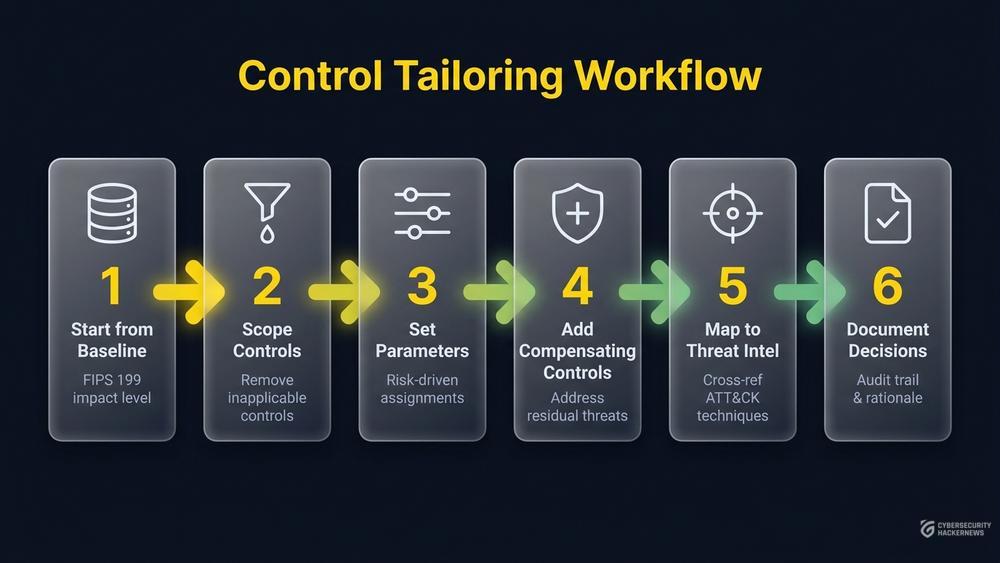
The following workflow turns tailoring from an abstract concept into a repeatable procedure your team can execute quarterly or whenever a major change occurs.
Prerequisites
Before you start, gather three artifacts: your system's FIPS 199 categorization (Low / Moderate / High), your most recent risk assessment per NIST SP 800-30 Rev. 1 [3], and an up-to-date system boundary diagram showing data flows, external interfaces, and technology components.
Step 1 — Start from the Correct Baseline
Select the control baseline that matches your system's impact level. NIST SP 800-53B publishes Low, Moderate, and High baselines. Load the baseline into a machine-readable format—NIST provides OSCAL (Open Security Controls Assessment Language) profiles for this purpose. Working from a structured profile rather than a PDF reduces transcription errors and makes downstream automation possible.
Step 2 — Scope and Identify Applicable Controls
Walk through every control in the baseline and ask: "Does this control apply to the technologies, roles, and data types present in this system?" Remove controls that are genuinely inapplicable. For example, if your system processes no cryptographic keying material on behalf of other organizations, control SC-12(1) (Availability) may not apply. Document the rationale for every removal.
Step 3 — Set Control Parameters
Many SP 800-53 controls contain assignment or selection operations—placeholders where the organization fills in values. AC-2 (Account Management), for instance, requires you to define which account types are permitted and the frequency of account reviews. Set these parameters based on your risk assessment, not on convenience. A system processing health records under HIPAA may need monthly privileged-account reviews, while an internal wiki may operate on a quarterly cycle.
Step 4 — Add Compensating and Supplementary Controls
If your risk assessment identifies threats that the baseline does not adequately address, add controls. A system exposed to advanced persistent threats might supplement the Moderate baseline with SI-4(4) (Inbound and Outbound Communications Traffic) even though it is normally a High-baseline control. Each addition should trace back to a risk statement.
Step 5 — Map to Organizational Threat Intelligence
Cross-reference your tailored control set against adversary techniques relevant to your sector. MITRE ATT&CK catalogs adversary tactics and techniques [4]. If your threat model highlights Phishing (T1566) as a primary initial-access vector, confirm that controls in the Security Awareness and Training (AT) and System and Information Integrity (SI) families are parameterized aggressively enough to detect and prevent that technique.
Step 6 — Document Tailoring Decisions
Every scoping exclusion, parameter assignment, and control addition goes into a tailoring document. This document is your audit trail and your onboarding resource. Capture the control ID, the decision (apply / modify / exclude / add), the rationale, the responsible party, and the date. Your tailoring documentation guidelines should specify a review cadence—typically aligned with the RMF Monitor step, or whenever the system undergoes a significant change.
Common Pitfalls in the Tailoring Process
See the dedicated section below for detailed anti-patterns.
Best Practices
The following practices move tailoring from a one-time checkbox exercise to a living part of your security program.
| Practice | Detail |
|---|---|
| Anchor every decision to a risk statement | A control is applied because a specific risk exists, not because it is on a list. |
| Automate baseline management | Use OSCAL profiles so parameter changes propagate consistently. |
| Peer-review tailoring decisions | A second analyst or risk owner reviews exclusions before sign-off. |
| Version-control the tailoring document | Track changes over time so you can explain the evolution during assessments. |
| Reassess after architectural changes | A cloud migration, new data type, or vendor change may invalidate prior scoping decisions. |
| Align parameters with threat intelligence | Update control parameters when your threat model changes, not only on a fixed schedule. |
NIST SP 800-53 Rev. 5 supports nist 800-53 control optimization by allowing organizations to create overlays—community-wide or sector-specific customizations layered on top of tailored baselines [1]. If your sector (healthcare, defense, financial services) publishes an overlay, start there and tailor further.
Tools Comparison
| Tool | Type | Tailoring Support | Format |
|---|---|---|---|
| NIST OSCAL Tools | Open-source | Native OSCAL profile and catalog editing | JSON / XML / YAML |
| Trestle (IBM) | Open-source | CLI-driven OSCAL authoring, validation, and transformation | JSON / Markdown |
| OpenControl | Open-source | Lightweight compliance-as-code framework | YAML |
| eMASS (DoD) | Government | Full RMF lifecycle including tailoring documentation | Proprietary |
| RegScale | Commercial | Continuous compliance with OSCAL import/export | SaaS |
| Xacta (Telos) | Commercial | Risk and compliance management with SP 800-53 baselines | SaaS / On-prem |
Consult each tool's official documentation for version-specific capabilities and licensing.
Decision Matrix: Should You Apply, Modify, or Exclude a Control?
Use this matrix during Step 2 and Step 3 of the tailoring workflow. For each control in the baseline, answer the three questions in order. The first "Yes" you hit determines your action.
| # | Question | If Yes → Action |
|---|---|---|
| 1 | Does your risk assessment identify a threat this control directly mitigates for your system? | Apply — set parameters according to your risk tolerance. |
| 2 | Does the control address a relevant threat, but the prescribed implementation does not fit your architecture? | Modify — adjust parameters or substitute a compensating control, and document the rationale. |
| 3 | Is the technology, data type, or operational scenario the control assumes genuinely absent from your system? | Exclude — record the scoping justification and the residual-risk acceptance by the risk owner. |
| 4 | None of the above yields a clear answer? | Escalate — flag for risk-owner review and a deeper threat-model analysis before deciding. |
To adapt this matrix to your environment, add a column for the risk owner's name and the review date. Feed completed rows into your tailoring document so every decision has a traceable path from risk assessment through control disposition.
Control Effectiveness Measurement
After tailoring, you need evidence that your selected controls actually work. Control effectiveness measurement turns tailoring from a paper exercise into an operational feedback loop.
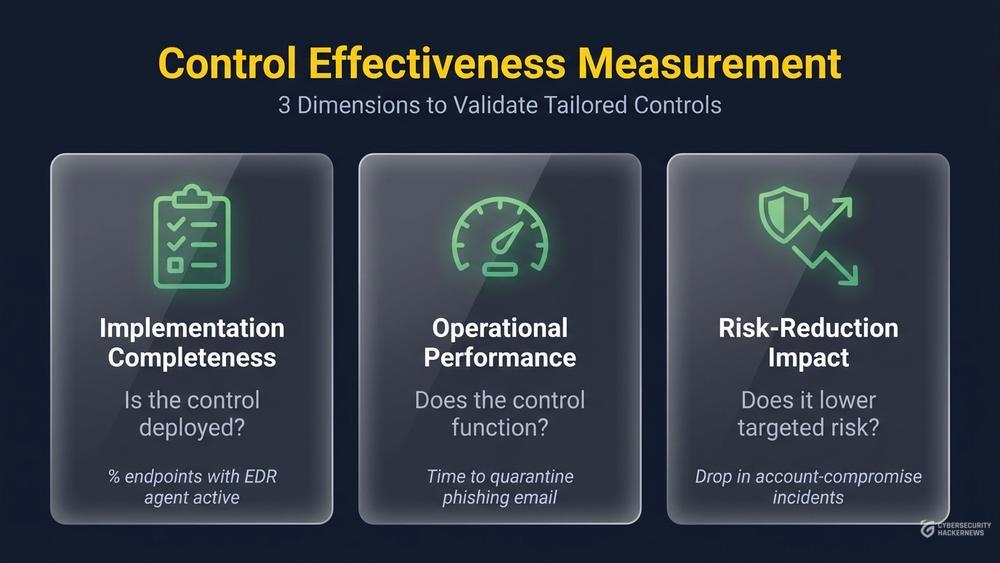
Build a measurement approach around three dimensions:
| Dimension | What You Measure | Example Indicator |
|---|---|---|
| Implementation completeness | Whether the control is deployed as specified | Percentage of endpoints with required EDR agent active |
| Operational performance | Whether the control functions correctly under load | Mean time between a simulated phishing email delivery and its quarantine |
| Risk-reduction impact | Whether the control demonstrably lowers the targeted risk | Reduction in successful account-compromise incidents after MFA parameter tightening |
Tie measurement results back to your tailoring document. If a control scores poorly on operational performance, that is a signal to revisit its parameters—or to investigate whether a compensating control is needed. NIST SP 800-53A provides detailed assessment procedures for each control family that you can use as a starting point for your measurement program.
Real-World Example (Illustrative Scenario)
⚠️ Disclaimer: The following scenario is an illustrative example based on typical industry patterns. The specific metrics are hypothetical estimates designed to demonstrate realistic outcomes, not measured data from a documented project. They should not be cited as factual benchmarks.
Context: A mid-size healthcare organization operates a Moderate-impact electronic health records (EHR) system. The security team of six manages compliance with HIPAA and NIST SP 800-53.
Challenge: The team inherited a Moderate baseline applied without tailoring. The control set contained requirements for mainframe-specific controls the organization did not operate, while cloud-native API protections were absent. Audit preparation consumed excessive analyst hours because the team had to explain inapplicable controls rather than demonstrating effective ones.
Solution: The team executed the six-step workflow above. They scoped out controls tied to technologies absent from their environment, tightened parameters for access control and audit logging based on a fresh risk assessment, and added supplementary controls for API security aligned with their cloud architecture. All decisions were recorded in an OSCAL-based tailoring document and version-controlled.
Results (illustrative estimates):
- Audit preparation effort reduced by approximately 60% due to a smaller, defensible control set (illustrative)
- Time spent investigating false-positive compliance findings dropped by roughly 55% (illustrative)
- Coverage of cloud-native threat scenarios improved by an estimated 70% after adding supplementary controls (illustrative)
- Tailoring review cycle shortened to quarterly instead of ad-hoc (illustrative)
Key Takeaways: Tailoring reduced noise in the compliance process while closing genuine gaps. The OSCAL-based document made reviews faster because changes were versioned and traceable. Anchoring every decision to a risk statement made audit conversations about risk rather than about checkbox coverage.
Common Pitfalls
These mistakes surface repeatedly in tailoring engagements. Each one carries real consequences.
| # | Anti-Pattern | Consequence | What to Do Instead |
|---|---|---|---|
| 1 | Copy-paste from another system's tailoring document | Inherited scoping decisions may not match your threat model or architecture, creating blind spots. | Run the decision matrix against your own risk assessment for every control. |
| 2 | Excluding controls without documented justification | Auditors treat undocumented exclusions as findings; assessors may require re-baselining. | Record the rationale, the risk owner's acceptance, and the date for every exclusion. |
| 3 | Setting parameters to the least restrictive value to avoid operational friction | Weak parameters (e.g., annual password rotation, 180-day account reviews) undermine the control's protective value. | Derive parameter values from your risk assessment, not from what is easiest to implement. |
| 4 | Treating tailoring as a one-time project | Systems change, threats evolve, and new vulnerabilities emerge. Stale tailoring creates drift between documented and actual risk posture. | Schedule tailoring reviews at a defined cadence and after every significant architectural or threat-landscape change. |
| 5 | Ignoring compensating controls when a primary control is infeasible | Declaring a control "not applicable" without a compensating measure leaves the underlying risk unaddressed. | If you cannot implement the prescribed control, identify and document a compensating control that addresses the same risk. |
| 6 | Failing to align tailoring with threat intelligence | Controls that do not map to real adversary behavior provide compliance without security. | Cross-reference your tailored set with ATT&CK techniques relevant to your sector after each threat-model update. |
Next Steps
- Export your current baseline into OSCAL format using the NIST OSCAL tools or Trestle CLI, so your tailoring decisions become machine-readable and version-controlled.
- Run the decision matrix against every control in your baseline within the next sprint cycle—start with the Access Control (AC) and System and Information Integrity (SI) families, which tend to have the most parameters requiring organization-specific values.
- Schedule a cross-functional review with your risk owner, system architect, and a peer analyst to validate your first round of scoping exclusions before the next assessment window.
- Establish a measurement cadence for control effectiveness measurement using the three-dimension table in this article, feeding results back into your tailoring document so your next review is data-driven.
Sources
[1] Joint Task Force, "Security and Privacy Controls for Information Systems and Organizations," NIST Special Publication 800-53, Revision 5, National Institute of Standards and Technology, 2020. [Online]. Available: https://csrc.nist.gov/pubs/sp/800/53/r5/final
[2] Joint Task Force, "Risk Management Framework for Information Systems and Organizations: A System Life Cycle Approach for Security and Privacy," NIST Special Publication 800-37, Revision 2, National Institute of Standards and Technology, 2018. [Online]. Available: https://csrc.nist.gov/pubs/sp/800/37/r2/final
[3] Joint Task Force Transformation Initiative, "Guide for Conducting Risk Assessments," NIST Special Publication 800-30, Revision 1, National Institute of Standards and Technology, 2012. [Online]. Available: https://csrc.nist.gov/pubs/sp/800/30/r1/final
[4] MITRE, "MITRE ATT&CK," The MITRE Corporation. [Online]. Available: https://attack.mitre.org/